
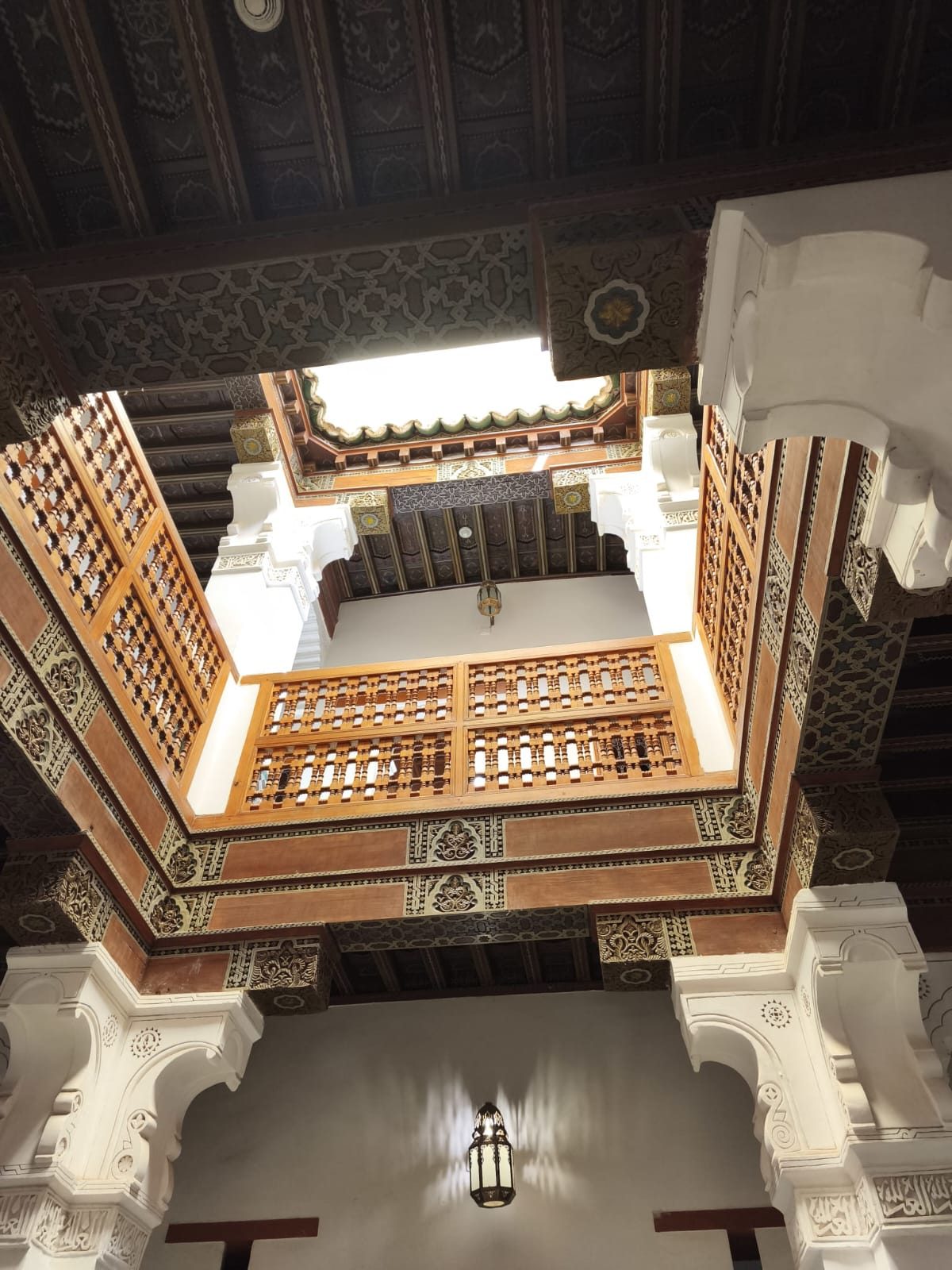
Jewish communities lived in Morocco for many centuries, in the great cities and in small towns of the Atlas and the coast. Most have since left, but the places they built are still there: the walled Jewish quarters called mellahs, synagogues, cemeteries and the shrines of saints that are still visited on pilgrimage.
This guide covers where that history can be seen today, city by city, and how to fit it into a trip.
What is a mellah?
A mellah is the Jewish quarter of a Moroccan city. The first was built in Fes in the 15th century. The second was in Marrakech, in 1558, under the Saadian sultan Moulay Abdallah. Later most Moroccan cities and many towns had one, and the word is still used for these quarters today, even where no Jewish families remain.
Fes: the first mellah
The best-known building in the Mellah of Fes is the Ibn Danan synagogue. The present building dates from about 1701; it was restored with the World Monuments Fund and reopened in 1999.
Fes is also the city of al-Qarawiyyin, founded in 859, so a day in the Mellah combines easily with the old medina and the Jewish cemetery.
Sefrou: “Little Jerusalem”
Sefrou is a small town 32 km from Fes, about forty minutes by road. It was known as “Little Jerusalem” for the size of its Jewish community, and Jewish and Muslim families lived side by side in its old town until the late 1960s. The mellah is still there, and Sefrou makes an easy half-day from Fes.
Marrakech: the Mellah and Slat al-Azama
The Marrakech Mellah dates from the 1550s; the date is noted on the door of the Jewish cemetery. In the Mellah:
- Slat al-Azama, a synagogue across from the jewellers’ market.
- The Jewish cemetery, which holds the tomb of the saint Hanania Cohen.
Our Marrakech city tour can include the Mellah; tell us when you book.
Demnate and the Atlas
Jewish life in Morocco was not only urban. Around Marrakech there were Jewish communities in many Atlas towns and villages:
- Demnate, east of Marrakech: Jews lived there in the 1100s, four centuries before the Marrakech mellah. In 1883 there were 1,700 Jews in a town of 4,000; the mellah dates from 1887. No Jewish families live there today, but the cemetery holds four Jewish saints, among them Rabbi David El Draa Halevy, whose tomb is the site of an annual pilgrimage, the hiloula.
- The Ourika valley, where Jews lived in 18 settlements. At Aghbalou there is the shrine of Rabbi Salomon Bel-Hench.
Essaouira: the Atlantic port
Essaouira, the old Mogador, was a trading port with a famously mixed population; UNESCO describes its history as Muslim, Christian and Jewish. In the late 1880s Jews made up almost 40 percent of the town’s people, and the mellah covers over a tenth of the town. Visit the Slat Lkahal synagogue in the mellah, and the Jewish cemetery just outside the city gates.
Essaouira is 185 km from Marrakech, about 2 h 40 by road, so it works as a day trip from Marrakech or as a stop on a longer route.
Casablanca: the Museum of Moroccan Judaism
The Museum of Moroccan Judaism in Casablanca opened in 1997. It is described as the only museum devoted to Judaism in the Arab world. Casablanca is where most international flights land, so the museum is a natural first or last stop.
How to plan a Jewish heritage trip
Distances between the main sites, measured by road with no stops:
| Leg | Distance | Driving time |
|---|---|---|
| Casablanca to Rabat | 92 km | 1 h 11 |
| Rabat to Meknes | 145 km | 1 h 45 |
| Fes to Sefrou | 32 km | 0 h 38 |
| Fes to Marrakech | 531 km | 5 h 57 |
| Marrakech to Essaouira | 185 km | 2 h 42 |
Two practical points:
- Synagogue visits and Shabbat with a community need arranging in advance. Some sites have restricted access, so give your dates early.
- Plan around Shabbat if you want to attend services, and allow for the long Fes-Marrakech drive.
We run two private itineraries built around this history: the 10-day Jewish heritage tour of Morocco, from Casablanca through Rabat, Meknes, Fes and Sefrou to Marrakech, and the 9-day Andalusian and Jewish heritage tour, which adds Essaouira and Demnate. Both can be adjusted to your dates; see all our city tours and circuits or contact us.